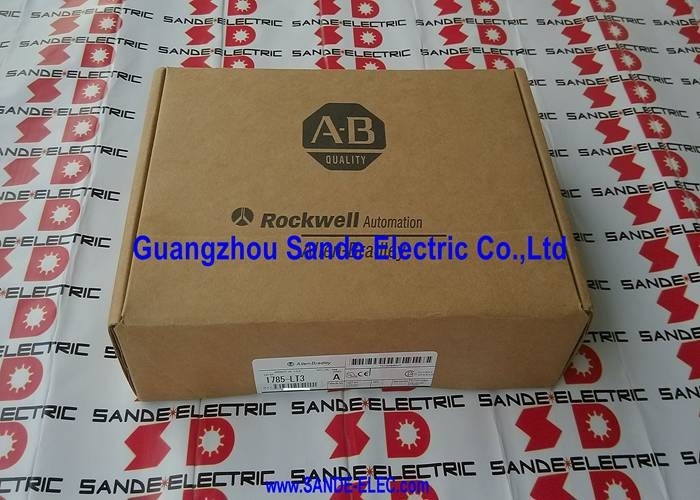
1785-LT3 | PLC-5/12 Processor — 6K Word SRAM / 1×DH+ / 1×Remote I/O / 2.5A @ 5VDC / Discontinued Legacy Spare
PLC-5/12 — Where It Sits in the PLC-5 Family
The PLC-5 processor family spanned a wide range of memory capacities and communication channel counts — from the smaller 5/11 and 5/12 variants at the entry end to the 5/60 and 5/80 at the top. The 1785-LT3 (PLC-5/12) sits near the entry level: 6K words of programme and data memory, one DH+ channel, and one Remote I/O channel.
For context against larger PLC-5 processors described in this product range, the PLC-5/12 has 6K words compared to 64K words on the PLC-5/60. It has one DH+ channel (shared with RIO) compared to four independent DH+/RIO channels on the 5/60. This positions the PLC-5/12 firmly in smaller, simpler machine control applications — conveyor sections, standalone machine cells, dedicated process stations — where the total programme and data memory fits within the 6K limit and one communication channel serves all networking needs.
The 2.5A backplane current at 5VDC is the power budget available to the I/O rack. I/O module selection must account for this limit; a fully populated rack with many analogue modules may approach the supply capacity.
Key Specifications
| Parameter | Value |
|---|
| Processor | PLC-5/12 |
| User Memory | 6K words SRAM |
| DH+ Channel | 1 |
| Remote I/O Channel | 1 (shared) |
| Backplane Current | 2.5A @ 5VDC |
| Status | Discontinued |
DH+ and Remote I/O — One Channel, Two Roles
The 1785-LT3 provides one communication channel that can operate as either DH+ or Remote I/O:
DH+ (Data Highway Plus): The PLC-5/12 connects to a DH+ network segment for programming access, peer-to-peer data exchange with other PLC-5 controllers, and HMI communication (PanelView terminals, SCADA via 1784-KT gateway).
Remote I/O: The PLC-5/12 scans remote I/O racks connected via Remote I/O cable. Remote racks expand the I/O capacity of the 1785-LT3 system beyond the local rack, distributing I/O modules to machine sections physically separate from the main control panel.
Application Scenarios
Standalone machine control: A dedicated 6K programme handles a single machine function — a punch press cycle, a conveyor speed control loop, a filling station sequence. The DH+ channel links the PLC-5/12 to a programming workstation and a PanelView operator terminal.
Remote I/O expansion: The main control panel contains the PLC-5/12 CPU rack; a remote I/O rack at the machine collects field sensor and actuator wiring. The Remote I/O channel on the 1785-LT3 scans the remote rack as part of the normal scan cycle.
Replacement in installed PLC-5/12 systems: The 1785-LT3 appears in machines and processes installed in the 1990s and 2000s that remain in production. A direct processor replacement preserves the programme environment, I/O addressing, and DH+ network behaviour of the installed system.
FAQ
Q1: What is the maximum I/O count for the 1785-LT3 PLC-5/12?
The PLC-5/12 supports a defined maximum I/O point count based on its memory size and I/O image table. With 6K words of memory, the usable I/O image table is smaller than on larger PLC-5 variants. The specific I/O capacity limit should be confirmed from the PLC-5/12 product data sheet — it is significantly less than the 3072-point capacity of the PLC-5/60. For installations requiring expanded I/O, remote I/O racks connected via the single RIO channel provide additional I/O capacity within the 1785-LT3's addressing limits.
Q2: What programming software is used for the 1785-LT3?
RSLogix 5 is the programming environment for the PLC-5 family including the PLC-5/12. Connection is via the DH+ channel using a 1784-KT, 1784-KTX, or compatible DH+ interface, or via the 1784-U2DHP USB-to-DH+ adapter for modern programming laptops. The programme is stored in the 6K-word SRAM; battery backup preserves the programme through power loss.
Q3: Can the 1785-LT3 communicate on an EtherNet/IP network directly?
No. The 1785-LT3 provides DH+ and Remote I/O as its native communication channels. EtherNet/IP is not natively supported. Bridging between DH+ and EtherNet/IP requires an external gateway device. The DH+ channel allows programming access and peer communication with other DH+-capable PLC-5 and SLC 500 controllers on the same segment.
Q4: How long does the SRAM battery last, and what happens on failure?
The PLC-5 processor uses a lithium battery to retain programme and data in SRAM during power loss. Battery life is typically 1–5 years depending on conditions. A BATT indicator illuminates when battery voltage falls below the retention threshold. On battery failure with power loss, all SRAM contents — programme and data — are lost. EEPROM backup modules (where compatible with the 1785-LT3) provide non-volatile programme storage for automatic programme recovery at power-up.
Q5: How does the PLC-5/12 (1785-LT3) compare to the PLC-5/15?
The PLC-5/12 has 6K words of user memory and one DH+/RIO channel. The PLC-5/15 provides more memory (typically 8K or higher depending on variant) and may offer two communication channels. For installations needing more programme space or dual-channel communication, the PLC-5/15 or larger PLC-5 variants are more appropriate. Confirm the installed processor model before ordering a replacement — the numeric suffix (12, 15, 25, 30) directly identifies the memory and capability class.



 Your message must be between 20-3,000 characters!