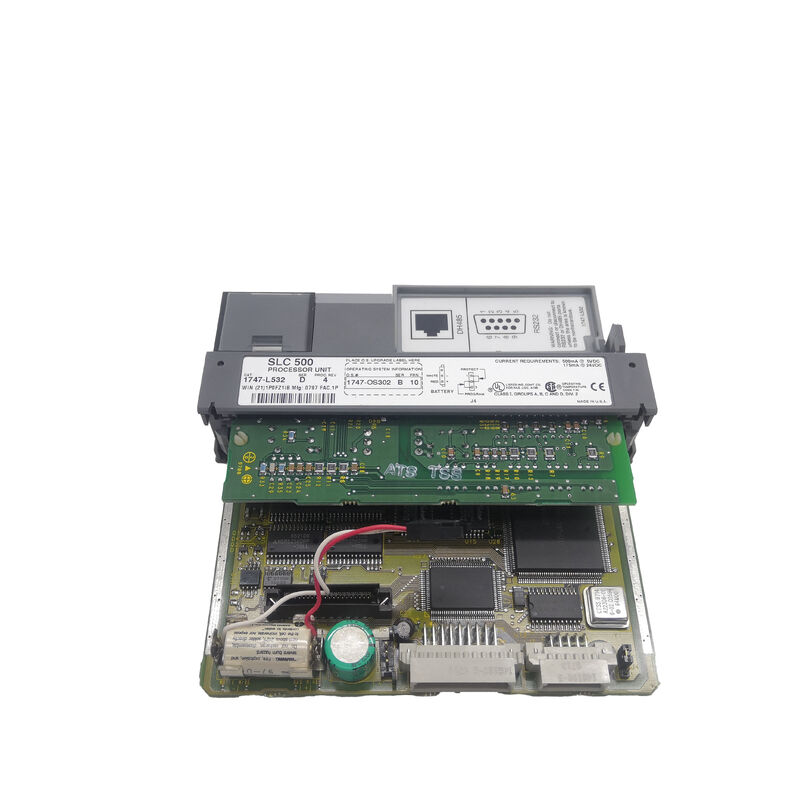
1747-L532 | SLC 500 SLC 5/03 Processor — 16K Word RAM / 4096 I/O / 480 Analog / RS-232 + DH-485 / Online Editing / Real-Time Clock
SLC 5/03 — The Mid-Range SLC 500 That Most Applications Actually Needed
When the SLC 500 was the dominant mid-range PLC across North American manufacturing through the 1990s and 2000s, the SLC 5/03 (1747-L532) occupied the sweet spot of the family. Above the entry-level 5/01 and 5/02 (limited by smaller memory and fewer features), and below the 5/04 and 5/05 (justified by Ethernet and very large programmes) — the 5/03 delivered the features that most real applications required: 16K words of programme and data memory, built-in RS-232 and DH-485 for HMI and programming connectivity, PID loops, floating-point maths, real-time clock, and online editing to modify programmes without stopping production.
Two additions over the 5/02 predecessor made the 5/03 significantly more useful for continuous operations. First, built-in RS-232 eliminated the need for an external communication module for PC programming access and HMI connection. The port supports DF1 full-duplex for SCADA and HMI point-to-point connections, switches to DH-485 for multi-drop network operation, and handles ASCII for barcode readers, printers, and weighing instruments — all without additional hardware. Second, 16K memory was substantial enough for complex programmes: multiple PID loops, recipe tables, data logging, and sequential control with comprehensive diagnostic reporting.
Key Specifications
| Parameter |
Value |
| User Memory |
16K words battery-backed RAM |
| Max. I/O |
4096 inputs / 4096 outputs |
| Max. Analog |
480 channels |
| Local Chassis |
3 (30 slots total max.) |
| RS-232 |
DF1 / DH-485 / ASCII |
| DH-485 |
Integrated |
| Real-Time Clock |
Yes |
| Online Editing |
Yes |
| Scan |
1ms per 1K programme |
| Battery |
1747-BA |
| Status |
Discontinued |
Communication Architecture — RS-232 and DH-485
DH-485 is the SLC 500's multi-drop network. Up to 32 nodes share a single DH-485 segment — SLC 500 controllers, PanelView HMI terminals, and PC-based SCADA systems via 1761-NET-AIC adapters. The 1747-L532 can receive programme downloads, serve online monitoring, respond to HMI read/write commands, and exchange peer-to-peer data with other SLC 500 controllers on the same DH-485 segment.
RS-232 provides point-to-point connection for laptop programming (via USB-to-RS-232 adapter), local HMI panels using DF1 protocol, and ASCII-mode devices. The port switches between DF1 full-duplex, DF1 half-duplex, DH-485, and ASCII in software — one physical port serves different connectivity needs without hardware changes.
For wider networking — ControlNet or EtherNet/IP — additional communication modules install in the SLC 500 chassis slots alongside the CPU.
Advanced Instructions — Beyond Basic Logic
The SLC 5/03 instruction set expanded significantly over the 5/01 and 5/02:
PID: Built-in Proportional-Integral-Derivative control in a single instruction. Multiple simultaneous loops, configurable gains, anti-windup, and derivative filtering — all native to the SLC 5/03 without additional function modules.
Floating-point maths: 32-bit IEEE floating-point operations including trigonometric functions and logarithms — essential for engineering unit scaling, sensor linearisation, and PID calculation.
STI (Selectable Timed Interrupt): Executes a subroutine at a fixed interval independent of the main scan, ensuring PID and data logging functions run at consistent sample rates regardless of main programme variation.
Indirect addressing: Array processing and recipe management using pointer values rather than fixed addresses — enabling the data structures that real-world process applications require.
Application Scenarios
Process control replacement: Chemical, water, and food processing systems built on SLC 5/03 architecture. A 1747-L532 replacement restores the processor with the programme loaded from RSLogix 500 or from a EPROM backup, preserving DH-485 HMI links and Remote I/O rack wiring intact.
Packaging and conveyor systems: Multi-loop control, recipe-based product changeover, and real-time production counting using the clock. Online editing allows minor logic corrections without production stops.
HVAC and building services: PID temperature loops, alarm logging with real-time clock timestamps, and RS-232 connection to building management systems via DF1 or ASCII.
FAQ
Q1: How is the programme preserved when the battery fails?
The 1747-BA battery maintains RAM when the CPU is powered off. Battery life is typically 1–3 years. When the BATT LED illuminates, replace the battery before shutdown. A 1747-M13 Flash EPROM backup module stores a programme backup that reloads automatically at power-up without a programming terminal. Without Flash backup, the programme must be downloaded from RSLogix 500 after battery failure.
Q2: The spec lists 3 chassis and 30 slots — are the 30 slots per chassis or total?
30 slots is the total across all three local chassis — not 30 per chassis. Individual SLC 500 chassis come in 4, 7, 10, and 13 slot configurations. The CPU occupies one slot itself, leaving 29 for I/O and communication modules across the three chassis. For more than 30 local slots, Remote I/O scanner modules extend the system to additional remote racks.
Q3: Can the SLC 5/03 communicate with modern EtherNet/IP controllers?
Not natively. Built-in communication is RS-232 and DH-485 only. A 1747-KFC15 Ethernet interface module installed in the SLC 500 chassis bridges the SLC 5/03 to EtherNet/IP for MSG instruction data exchange with modern Logix controllers. Alternatively, protocol gateways bridge DH-485 or RS-232 to EtherNet/IP. Direct EtherNet/IP is a capability of the SLC 5/05 variant (1747-L551/L552/L553), not the 5/03.
Q4: What are the limitations of online editing on the SLC 5/03?
Online editing adds or modifies ladder rungs while the processor is in REM RUN mode without stopping the scan. The rung enters an edit zone held pending until the engineer accepts it, at which point it goes live. Rungs with complex instructions (file operations, SFC elements) may have editing restrictions. During online editing the processor continues scanning and controlling outputs — an incorrect edit produces an incorrect output immediately. The key switch must be in REM position for online editing; the RUN position locks programme changes.
Q5: Where is the 1747-L532 sourced after discontinuation?
Through the SLC 500 legacy spare parts market — industrial automation dealers, tested surplus suppliers, and specialist legacy PLC services. The SLC 500 platform has a very large installed base with systems remaining in production globally. The SLC 5/03 (1747-L532) is one of the most widely stocked SLC 500 variants in the aftermarket. Confirm the 1747-L532 catalog number and verify the battery (1747-BA) before ordering. Load the programme from an RSLogix 500 archive or EPROM module backup before returning the machine to service.



 Your message must be between 20-3,000 characters!