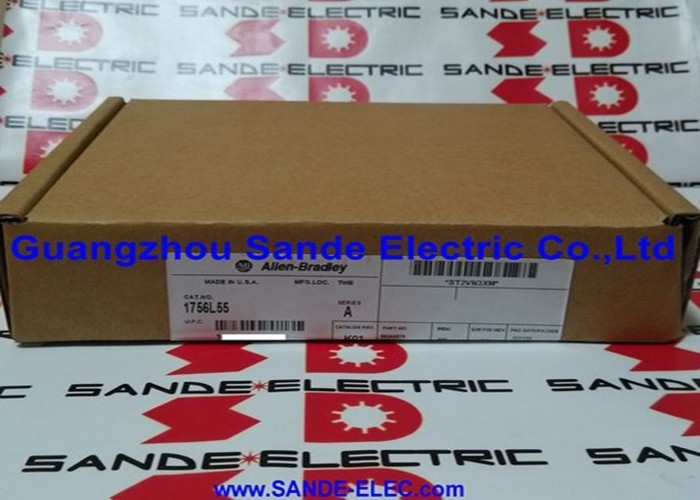
1756-L55 | ControlLogix Logix5555 Processor — No Built-in Memory / Add 1756-M Board / 250 Local I/O / EtherNet/IP ControlNet DeviceNet / 0–60°C / 0.34kg
No Built-in Memory — The Core Characteristic of the 1756-L55
Most later ControlLogix CPUs integrate programme and data memory directly into the processor module. The 1756-L55 does not. It requires a separate 1756-M series memory board installed alongside the CPU in the same chassis slot.
The memory board installs inside the 1756-L55 module. The 1756-L55 occupies one chassis slot; the memory board is part of the same physical assembly. Memory options cover a wide capacity range:
| Memory Board |
User Memory |
I/O Memory |
Battery |
| 1756-M12 |
750KB |
208KB |
Required |
| 1756-M13 |
1.5MB |
208KB |
Required |
| 1756-M14 |
3.5MB |
208KB |
Required |
| 1756-M16 |
7.5MB |
208KB |
Required |
| 1756-M22 |
750KB |
208KB |
Not required (NVRAM) |
| 1756-M23 |
1.5MB |
208KB |
Not required (NVRAM) |
| 1756-M24 |
3.5MB |
208KB |
Not required (NVRAM) |
For applications where battery backup is undesirable — hazardous area panels, mobile equipment, installations with infrequent maintenance cycles — the 1756-M22/M23/M24 nonvolatile memory boards retain programme content without battery, eliminating the scheduled replacement requirement.
Key Specifications
| Parameter |
Value |
| Processor |
Logix5555 |
| Built-in User Memory |
None |
| Backplane (5.1VDC) |
1.23–1.25A |
| Backplane (24VDC) |
0.014A |
| Power Dissipation |
5.6–5.7W |
| Thermal |
19.1–19.4 BTU/hr |
| Isolation |
30V continuous |
| Battery (std) |
1756-BA1 |
| Operating Temp |
0°C to 60°C |
| Storage Temp |
−40°C to 85°C |
| Weight |
0.34 kg |
| Local I/O (max) |
250 modules |
| Distributed I/O (max) |
4800 points |
| Backplane Speed |
up to 5Mbps |
Scale — 250 Local I/O Modules, 4800 Distributed Points
The 1756-L55 operates within the ControlLogix distributed I/O architecture. Up to 250 local I/O modules mount on ControlLogix chassis backplanes accessible to this processor. For distributed applications — remote I/O drops over EtherNet/IP, ControlNet, or DeviceNet — the total reaches 4800 distributed I/O points. Backplane communication runs at up to 5Mbps, supporting real-time I/O updates across a dense I/O configuration.
The communication network is not built into the 1756-L55 itself. Network connectivity comes from 1756-series communication modules installed in adjacent chassis slots:
- EtherNet/IP: 1756-ENET or 1756-ENBT modules
- ControlNet: 1756-CNB or 1756-CNBR modules
- DeviceNet: 1756-DNB module
This modular communication approach allows the same 1756-L55 processor to be configured for different network topologies — EtherNet/IP only, ControlNet ring, multi-network hybrid — by selecting the appropriate communication modules.
Application Scenarios
Automotive assembly line: ControlLogix chassis with 1756-L55 and 1756-M13 (1.5MB) memory board running complex sequential logic for welding, clamping, and material handling. EtherNet/IP via 1756-ENBT module connects robot controllers and vision systems. ControlNet via 1756-CNB handles deterministic I/O updates to remote I/O drops across the line.
Water treatment plant: 1756-L55 with 1756-M12 (750KB) managing pump sequencing, valve control, and PID loop monitoring. DeviceNet via 1756-DNB integrates variable speed drives; EtherNet/IP connects the SCADA system and HMI panels.
Food and beverage production: 1756-L55 with 1756-M22 (NVRAM, no battery) in a washdown environment panel. The nonvolatile memory eliminates battery replacement scheduling in a hard-to-access location.
FAQ
Q1: Can the 1756-L55 operate without a memory board installed?
No. Without a 1756-M memory board, the 1756-L55 has no user programme storage and cannot execute any logic. The memory board is a required component. The processor and memory board form the complete CPU assembly — specify both the 1756-L55 and the appropriate 1756-M board when ordering or replacing a system.
Q2: What programming software and languages does the 1756-L55 support?
RSLogix 5000 is the programming environment for the 1756-L55, with connection via the RS-232C programming port or through an EtherNet/IP or ControlNet communication module. RSLogix 5000 supports Ladder Diagram, Function Block Diagram, Structured Text, and Sequential Function Chart in accordance with IEC 61131-3. For newer firmware revisions, Studio 5000 Logix Designer provides the same programming languages with an updated interface.
Q3: When does the 1756-BA1 battery need replacement, and what happens if it fails?
Battery replacement is recommended approximately every 1–2 years, depending on ambient temperature and usage. The controller generates a battery low warning through its fault status before the battery reaches critical discharge. If the battery fails completely in a standard (non-NVRAM) memory configuration, the programme stored in volatile SRAM is lost on the next power cycle. The 1756-M22/M23/M24 nonvolatile memory variants do not require a battery; programme content is retained through power loss without a battery.
Q4: Is the 1756-L55 compatible with the current ControlLogix 5570 or 5580 chassis?
The 1756-L55 is physically compatible with any ControlLogix 1756-series chassis backplane. However, communication and firmware compatibility between the 1756-L55 (Logix5555 processor) and the newer L7x or L8x processors in the same chassis depends on the specific configuration. In practice, the 1756-L55 is maintained in existing Logix5555-based systems rather than mixed with newer generation processors. Verify the chassis and communication module compatibility matrix for specific multi-CPU configurations.
Q5: What is the difference between the 1756-L55 (no memory) and a complete configured unit such as the 1756-L55M12?
The 1756-L55M12 is the combined assembly of a 1756-L55 processor and a 1756-M12 (750KB) memory board. The "M12" suffix indicates which memory board is included. When ordering or replacing, "1756-L55" alone is the bare processor without memory; "1756-L55M12" (or M13, M14, M16, M22, M23, M24) indicates the specific memory board installed. For replacement purposes, confirm whether the failed component is the processor, the memory board, or both.


 Your message must be between 20-3,000 characters!