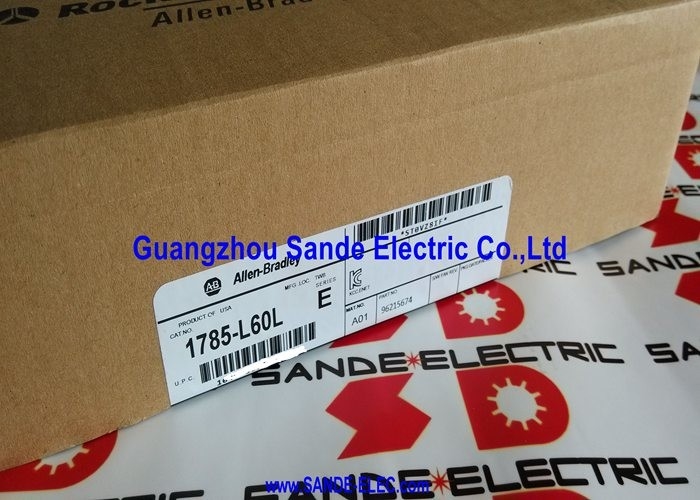
1785-L60L | PLC-5/60L Processor — 64K Word SRAM / Complementary 3072+3072 I/O / EEPROM Backup / 4 DH+/RIO
PLC-5/60L — The Complementary I/O Advantage Over the /60B
The 1785-L60L is the PLC-5/60L — the "L" variant of the 64K-word PLC-5/60 processor family. The standard PLC-5/60B (1785-L60B) supports a maximum of 3072 I/O points in any mix of inputs and outputs. The PLC-5/60L extends this with complementary I/O addressing: 3072 inputs and 3072 outputs separately, rather than 3072 shared across both directions.
Complementary I/O addressing matters in large process applications where the input count and output count each approach the standard limit independently. A chemical reactor system with 2800 field instrument inputs and 2000 output channels would exceed the 60B's 3072 shared limit. The 60L accommodates it — up to 3072 on each side simultaneously.
Memory capacity is identical to the 60B: 64K words of battery-backed SRAM, with EEPROM backup available through the 1785-ME series memory modules (ME16, ME32, ME64, and M100 capacities). The four DH+/Remote I/O communication channels, the RS-232 serial port, and the standard PLC-5 instruction set are the same.
Key Specifications
| Parameter |
Value |
| User Memory |
64K words (battery-backed SRAM) |
| EEPROM Backup |
Yes — 1785-ME16/ME32/ME64/M100 |
| Protected Memory |
No |
| I/O — Any Mix |
3072 |
| I/O — Complementary |
3072 in + 3072 out |
| Analog I/O |
3072 |
| DH+/RIO Channels |
4 |
| RS-232 |
1 |
| Weight |
0.45 kg |
| Status |
Discontinued |
Four DH+/RIO Channels — Independent Communication Domains
Each of the four communication channels operates independently. Possible simultaneous configuration:
- Channel 1 (DH+): Connection to DH+ network shared with programming workstations and SCADA servers.
- Channel 2 (Remote I/O): Scanner for local remote I/O racks.
- Channel 3 (Remote I/O): Scanner for remote racks at a second plant section.
- Channel 4 (Remote I/O): Scanner for a third group of remote racks.
All four channels and all remote I/O data appear in the same unified I/O image. The programme accesses any remote I/O point identically to a local point — the physical distribution is transparent to the ladder logic.
Application Scenarios
Large-scale process control: Refineries, chemical plants, and water treatment facilities where total field points exceed the PLC-5/60B's 3072 shared limit. The complementary I/O architecture allows independent scaling of input and output point counts.
Multi-section material handling: Four Remote I/O channels each scanning a separate plant section — warehouse entry, sorting, transfer, and shipping — with the 60L serving as the central station-level controller for all four areas.
PLC-5/60B replacement evaluation: When replacing a 60B, confirm whether the application uses complementary I/O addressing. If yes, the 60L is the correct replacement. If the total I/O stays within 3072 shared, either variant works.
FAQ
Q1: What is the practical difference between the PLC-5/60L and PLC-5/60B?
Both have 64K-word memory and four DH+/RIO channels. The 60B supports up to 3072 I/O points in any mix of inputs and outputs from that total. The 60L uses complementary addressing — 3072 inputs and 3072 outputs as separate counts. Specify the 60L when either the input count or output count independently approaches 3072.
Q2: Does the EEPROM backup module replace the need for a battery?
The EEPROM module provides non-volatile programme backup independent of the battery. On power-up with a healthy EEPROM module, the programme loads automatically without a programming terminal. However, retentive data (counter values, retentive flags, timer accumulators) resides in battery-backed SRAM and is not stored in the EEPROM. Both the EEPROM backup and a functional battery are recommended for full data retention.
Q3: What programming software is used for the 1785-L60L?
RSLogix 5 is the programming environment for the PLC-5 family. Connection is via the RS-232 channel using a 1784-U2DHP USB-to-DH+ adapter for DH+ network access, or via RS-232 direct cable for serial programming. For DH+ network programming from a PC, a compatible DH+ interface adapter is required.
Q4: Can PLC-5/60L racks accept standard 1746 SLC 500 I/O modules?
No. PLC-5 systems use 1771 I/O modules, not 1746 modules. The 1785-L60L accepts 1771 series I/O racks and modules. Some 1771-to-1746 adapter solutions exist in the aftermarket, but these are application-specific and require compatibility verification. Standard field wiring connections use 1771 I/O modules directly.
Q5: Is the PLC-5/60L replacement by the 60B straightforward in an existing system?
Only if the system does not use complementary I/O addressing. If the original 60L programme was written using complementary addressing (separate input and output blocks above 3072 shared), installing a 60B — which does not support complementary addressing — will generate addressing conflicts. Review the hardware configuration and I/O map before substituting a 60B for a 60L in a running installation.



 Your message must be between 20-3,000 characters!