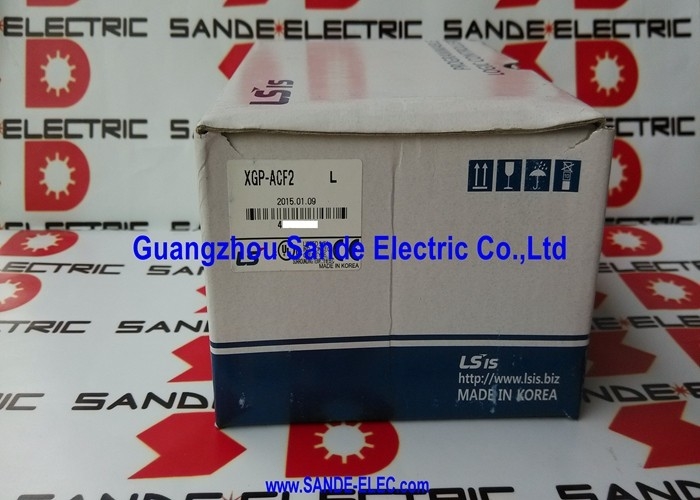
LSIS XGP-ACF2 | XGT Series PLC Power Supply Module — 85–264VAC Universal / DC5V 6A / ±2% / ≤20A Inrush / 50/60Hz / 0.4kg
Universal Input — One Module for All Mains Voltages
The XGP-ACF2's defining specification is its 85–264VAC input range. This is not a selectable-voltage supply requiring a jumper or switch to configure for 100V or 230V — it is a genuinely universal input that automatically adapts to any mains supply within the range. Japan's 100VAC, North America's 120VAC, and Europe's 220–240VAC all fall within specification.
For machine builders who ship XGT-based control panels to multiple markets, this universality eliminates market-specific power module variants and removes the risk of voltage mismatch. A panel built in Korea and shipped to Germany, Japan, or the United States powers on correctly without changing the supply module or adjusting any hardware settings. One part number covers all markets.
The XGP-ACF2 compares directly to the XGP-AC23 (fixed 220V input, 8.5A output) and XGP-DC42 (24VDC input). The AC23 has higher current capacity for larger module populations but requires a fixed 220VAC supply. The DC42 serves installations where 24VDC is the panel's primary distribution voltage. The ACF2 is the correct selection when universal input voltage compatibility and 6A output capacity match the installation's requirements.
Key Specifications
| Parameter |
Value |
| Input Voltage |
AC 85–264V (universal) |
| Frequency |
50/60Hz (47–63Hz) |
| Inrush Current |
≤20A peak |
| Output |
DC 5V ±2% |
| Output Current |
6A |
| Output Power |
~30W |
| Weight |
0.4 kg |
| Status |
Active |
6A Current Budget — System Design Requirement
The XGP-ACF2's 6A output is the total 5VDC available to every module installed in the same XGT base. Each module type draws a defined current from this budget. Typical draws:
- XGI-CPUU CPU module: ~0.96A
- Standard digital I/O module: ~0.2A
- Analogue I/O module: ~0.3A
- Communication module: ~0.3A
A representative configuration — one CPU (0.96A) + twelve digital I/O modules (2.4A) + two communication modules (0.6A) — draws approximately 3.96A, leaving over 2A of headroom. This margin accommodates additional modules and ensures stable regulation under varying loads.
The sum of all installed modules' current draws must be calculated and verified against the 6A limit before the system is powered. An overloaded supply droops the 5VDC rail below the ±2% regulation band — the result is intermittent module resets, communication errors, and unpredictable CPU behaviour rather than a clean shutdown, making overload conditions more difficult to diagnose than a hard fault.
Inrush Current and Circuit Protection Selection
The ≤20A peak inrush at power-on is the parameter that determines the correct upstream circuit protection. A standard fast-acting fuse sized close to the steady-state operating current will trip on the inrush surge. The correct protection choices are:
- Time-delay (slow-blow) fuses: Allow the brief inrush current to pass while providing overcurrent protection for sustained faults.
- Circuit breakers with Type D characteristic: Trip instantaneously at 10–20× rated current, accommodating inrush while protecting against sustained overload.
In facilities where multiple XGT racks power on simultaneously after an outage, the combined inrush from all power modules must also be considered at the distribution panel level.
Application Scenarios
Global machine deployment: XGT-based OEM control panels shipped to customers in Japan (100VAC), Germany (230VAC), and the USA (120VAC) — all using the same XGP-ACF2 without hardware modification or market-specific stocking.
New XGT system installation: Standard power module for XGI and XGR system builds where AC mains is available and 6A output capacity matches the planned module population.
XGP-ACF2 replacement in existing XGT installations: Direct swap when the original power module fails. No configuration needed — install, power on, and verify the 5VDC output is within the ±2% specification.
FAQ
Q1: What happens if the total module current exceeds 6A?
The output voltage droops below 4.9V (the ±2% lower limit), triggering marginal logic levels in installed modules. Depending on severity, the supply may enter current limiting or shut down. The failure mode is typically intermittent rather than hard — modules reset, communication errors occur, and CPU behaviour becomes unpredictable. Always verify the total current draw of all installed modules before energising the system.
Q2: Does the XGP-ACF2 require a voltage selector switch for 100V vs 220V operation?
No. The XGP-ACF2 is a true universal input supply — no selector switch exists because none is needed. Connect it to any AC supply between 85V and 264VAC at 47–63Hz and it operates correctly. The internal power electronics automatically regulate the output regardless of input voltage within the specified range.
Q3: Is the ≤20A inrush current a guaranteed maximum or a typical value?
It is a maximum — the actual inrush depends on the supply voltage's phase angle at the moment of energisation, capacitor temperature, and line impedance. At peak AC voltage phase, inrush is typically highest; at zero crossing, it is minimal. The ≤20A figure is the worst-case value for protection device selection purposes.
Q4: Can the XGP-ACF2 be used in XGR redundant CPU configurations?
Yes. In XGR redundant configurations, each chassis has its own independent power module. The XGP-ACF2 powers its own base's modules independently of the partner chassis's supply. Verify the specific XGR configuration requirements in the LS Electric XGT system documentation to confirm the appropriate power module variant for each chassis.
Q5: What does DC5V ±2% tolerance mean for module operation?
The output is guaranteed to remain between 4.9V and 5.1V under all specified operating conditions. All XGT modules are designed to operate correctly within this range. If the supply drifts outside ±2% — due to overload, input voltage out of range, or module failure — logic voltage margins in installed modules become marginal, causing the intermittent faults described in Q1.


 Your message must be between 20-3,000 characters!