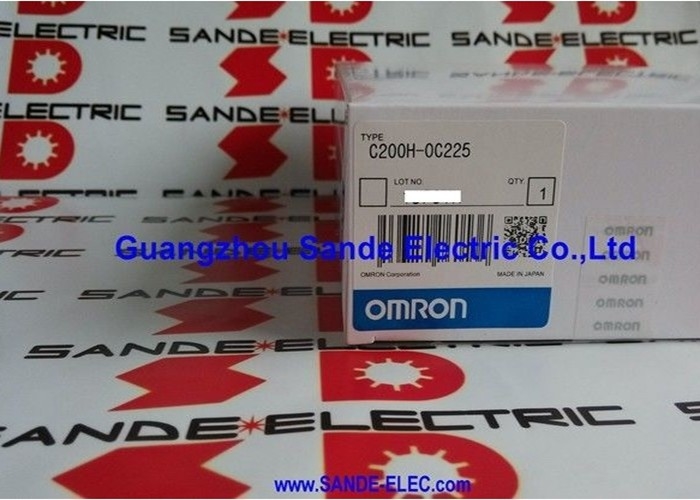
Omron C200H-OC225 | C200H 16-Point Relay Output Module — 250V AC / 24V DC / 2A per Point / G6B Relay
16 Relay Outputs for the C200H Rack
The C200H-OC225 expands a C200H PLC rack with 16 relay output points rated for 250V AC or 24V DC loads at 2A per output. The relay-type output is the defining characteristic of this module — each output channel switches through a mechanical contact, which makes it electrically compatible with a wider range of field loads than transistor or triac output modules: AC and DC loads mixed, inductive loads with higher surge tolerance, and devices requiring contact-closure rather than transistor-level signals.
The relay type used is the Omron G6B-1174P-FD-US — a 24V DC coil relay at each output channel. Relay mechanical life limits the long-term switching cycle count, which means this module is appropriate for outputs that switch at machine-event frequency rather than at high-rate pulse frequencies.
Key Specifications
| Parameter |
Value |
| Output Points |
16 |
| Rated Load |
250V AC / 24V DC |
| Current per Point |
2 A |
| Current per Unit |
8 A total |
| Min. Switching |
10 mA / 5V DC |
| Relay Type |
G6B-1174P-FD-US |
| Response Time |
10 ms (ON/OFF) |
Per-Point and Per-Unit Loading Limits
The 2A per-point rating is the maximum current a single output can switch. The 8A per-unit rating caps the total simultaneous current through all 16 points combined — even when each individual point is within its 2A limit, the sum of all active outputs must not exceed 8A.
In practical terms: loading all 16 outputs near their 2A individual limit simultaneously would push the unit total toward 32A — well above the 8A per-unit ceiling. In installations where several outputs drive loads simultaneously, calculate the worst-case concurrent current and verify it falls within 8A total. Exceeding this causes thermal damage to the module even when no individual relay is overloaded.
The minimum switching capacity of 10 mA at 5V DC confirms the G6B relay can switch low-energy pilot circuits without contact degradation — useful for signal-level loads alongside standard 24V I/O.
FAQ
Q1: What makes relay outputs preferable to transistor outputs in legacy machine panels?
Relay outputs switch AC and DC loads alike and handle inductive loads (contactors, solenoids) with better surge tolerance than transistor outputs. In legacy machine designs, the output type was selected to match the field wiring and load types in the original panel. Replacing with a relay module preserves the original output behaviour — no change to field wiring, no modification to external relay interface hardware.
Q2: Why is the 8A per-unit limit important even though each point is rated 2A?
The 8A per-unit limit is the thermal ceiling for the whole module simultaneously. If many outputs switch high-current loads at the same time, the combined current can exceed 8A even when no individual point exceeds 2A. Calculate the worst-case sum of all simultaneously active output currents and confirm it stays below 8A, or reduce the load per point to stay within the unit total.
Q3: What is the relay service life and when should the module be replaced preventively?
The G6B relay has a rated mechanical life (number of switching operations). In applications with high-frequency output switching, the relay contacts wear faster. As a general guidance, relay output modules in machines that cycle outputs many thousands of times per day should be included in the scheduled preventive maintenance cycle — not treated as permanent hardware until failure.
Q4: Is the C200H-OC225 still available for purchase?
The C200H series is a legacy Omron platform. The module may be sourced through the Omron C200H aftermarket — industrial PLC parts dealers, legacy Omron distributors, and refurbishment specialists. Confirm the C200H-OC225 part number specifically — adjacent C200H output modules (C200H-OC221, OC222, OC224) differ in point count or contact configuration.
Q5: What should be checked when replacing a C200H-OC225?
Confirm the replacement module is C200H-OC225 specifically (relay type, 16 points). Verify the field load per point and the sum of simultaneous loads against the 2A per point / 8A per unit limits. Check the rack backplane connector for pin condition. After installation, verify each output channel responds correctly to its PLC address before returning the machine to production.


 Your message must be between 20-3,000 characters!