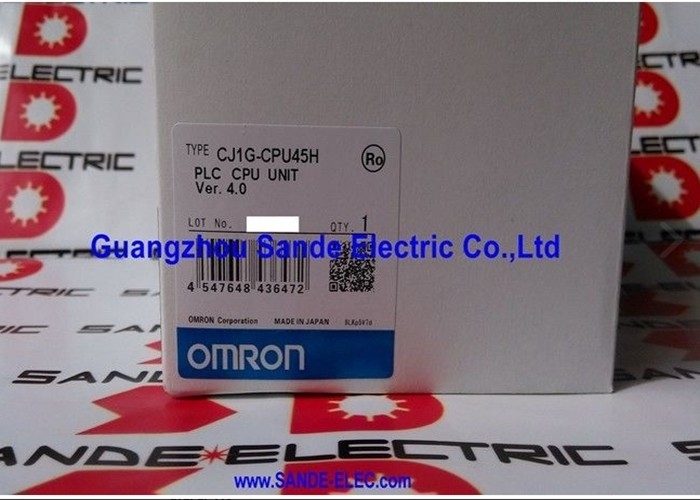
Omron CJ1G-CPU45H | CJ1 Modular PLC CPU — 60K Steps / 128K Words / 1280 I/O Bits / 3 Expansion Racks / 0.91A
CJ1G-CPU45H — The CJ1 Platform's Mid-High CPU
The CJ1G-CPU45H is a CPU unit in Omron's CJ1 modular PLC family — the predecessor platform to the CJ2M described elsewhere in this product set. Understanding where it sits in Omron's CPU hierarchy matters for both new specification and replacement work.
Within the CJ1G CPU range, the G designation identifies the standard performance class (versus CJ1H for high-performance). The CPU45H positions above the smaller CJ1G-CPU43H (20K steps, 960 I/O bits) with its 60K step programme and 1,280 I/O bit capacity — the higher count specifically suited to installations where the machine needs more complex logic and more signal connections than a mid-range CPU can accommodate.
The 1,280 I/O bits (equivalent to 80 words of I/O area) define the maximum number of physical input and output signals the CPU can address across its local rack and expansion racks. For a machine or system with 400 digital inputs, 300 digital outputs, and 32 analogue channels occupying multiple I/O words, the CJ1G-CPU45H has the addressing capacity to map all signals without workarounds.
Three expansion racks extend the CJ1G-CPU45H's physical reach — up to three additional racks, each connected via CJ1W-IC101 I/O interface units, expand the total I/O module count well beyond what fits in one physical cabinet. For machines where I/O is distributed across sections in separate panels connected back to one central CPU, this rack expansion is the mechanism that keeps all I/O under one programme and one addressing structure.
Key Specifications
| Parameter |
Value |
| Programme |
60,000 steps |
| Data Memory |
128,000 words |
| I/O Bits |
1,280 |
| Expansion Racks |
3 max |
| Current |
0.91A |
| Platform |
CJ1 (predecessor to CJ2M) |
CJ1G-CPU45H vs CJ2M-CPU14 — Two Generations of Omron Modular PLCs
| Feature |
CJ1G-CPU45H |
CJ2M-CPU14 |
| Programme |
60K steps |
50K steps |
| Data Memory |
128K words |
160K words |
| I/O |
1,280 bits |
2,560 points |
| Expansion |
3 racks |
40 units |
| Execution |
~0.1µs |
0.04µs |
| Generation |
CJ1 (older) |
CJ2M (newer) |
The CJ2M-CPU14 provides faster execution, more data memory, and greater expansion despite fewer programme steps. Both use the CJ-series I/O module family. For replacement in existing CJ1G installations, the CJ1G-CPU45H is the correct like-for-like replacement; migrating to CJ2M requires programme compatibility verification.
Application Scenarios
Multi-section machine control: Three expansion racks allow I/O modules in separate cabinets — a main processing section, a loading station, and a packaging section — all addressed under one CJ1G-CPU45H programme without separate PLCs or inter-PLC communication.
Process automation with large I/O: 1,280 I/O bits accommodate dense signal environments: a utility system with hundreds of valve position switches, level inputs, and motor status contacts managed from one CPU.
CJ1 legacy system spare: The CJ1 platform was widely deployed from the early 2000s. When a cabinet built around the CJ1G-CPU45H requires CPU replacement, an identical model preserves the programme, I/O addressing, and rack architecture without modification.
FAQ
Q1: How does the CJ1G-CPU45H differ from the CJ1G-CPU43H and CJ1G-CPU44H?
The CPU43H provides 20K steps and 960 I/O bits. The CPU44H provides 40K steps and 1,024 I/O bits. The CPU45H provides 60K steps and 1,280 I/O bits. All three support 3 expansion racks. Select the CPU based on programme size and I/O bit count requirements — replacing a CPU45H with a CPU43H reduces available programme memory and I/O addressing, which will prevent a large programme from loading.
Q2: Can the CJ1G-CPU45H use CJ2M I/O modules, and vice versa?
CJ1 and CJ2M share the CJ-series I/O module form factor. Most standard CJ1W-ID, OD, and AD series I/O modules are compatible with both CJ1 and CJ2M CPUs. Specialty modules (function units, specific communication processors) may have compatibility restrictions — verify from Omron's CJ-series compatibility tables before mixing CPUs and modules across generations.
Q3: How many total I/O points does 1,280 I/O bits represent?
1,280 I/O bits equals 1,280 individual digital signals — the maximum combined count of input bits and output bits addressable by the CPU across all racks. In practice, the limit may be reached before this by the physical module count or rack space. For analogue channels, each channel occupies multiple bits (typically 16 bits per channel), so analogue-heavy systems consume the 1,280-bit budget faster than purely digital systems.
Q4: What programming software connects to the CJ1G-CPU45H?
CX-Programmer (part of the CX-One suite) is the primary programming tool for the CJ1 family, supporting ladder diagram, function block diagram, structured text, and SFC programming. Connection is via the USB port on the CPU or via Ethernet if an optional Ethernet unit is installed. Sysmac Studio does not support CJ1 programming.
Q5: Where is the CJ1G-CPU45H sourced?
Through the Omron CJ1 PLC aftermarket — legacy automation dealers, tested surplus suppliers, and specialist Omron parts distributors. The CJ1 platform has a substantial global installed base; the CPU45H appears regularly in the aftermarket. Confirm programme capacity (60K steps) and I/O bit count (1,280) match the installed system before ordering.


 Your message must be between 20-3,000 characters!