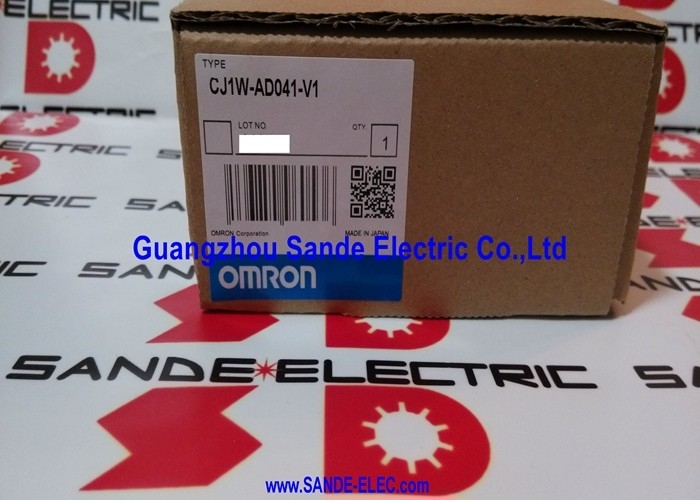
Omron CJ1W-AD041-V1 | CJ-Series 4-Channel Analog Input Unit — 1/8000 Resolution / 250µs per Point / Wire Break Detection / Peak Hold / Removable Terminal
Per-Channel Signal Range Selection — Maximum Flexibility in One Module
The CJ1W-AD041-V1 configures each of its four input channels independently. All five signal ranges — 1–5V, 0–5V, 0–10V, ±10V, and 4–20mA — are available on any channel without hardware jumpers or switches. Range assignment is made in the CJ CPU's I/O parameter table.
This per-channel independence is practical for mixed-signal instrumentation racks: channel 1 reads a 4–20mA pressure transmitter, channel 2 reads a ±10V servo feedback, channel 3 reads a 0–10V temperature transmitter output, and channel 4 reads a 1–5V level transmitter — all from one module, all at full resolution.
The resolution of 1/8000 (13-bit) provides 8,000 counts across the full input span. For the 4–20mA range, each count represents 2µA — sufficient for most industrial transmitter accuracy requirements. The optional 1/4000 setting reduces resolution but increases conversion throughput where only coarser measurement is needed.
Key Specifications
| Parameter |
Value |
| Channels |
4 (analog input only) |
| Signal Ranges |
1–5V, 0–5V, 0–10V, ±10V, 4–20mA |
| Resolution |
1/8000 (13-bit); can set to 1/4000 |
| Conversion Speed |
250µs/point (or 1ms/point) |
| Voltage Accuracy |
±0.2% |
| Current Accuracy |
±0.4% |
| Functions |
Wire break, peak hold, averaging |
| Terminal |
Removable screw block |
| I/O Bus |
CJ I/O Bus |
Wire Break Detection — Critical for 4–20mA Loop Integrity
The 4–20mA current loop's defining advantage over voltage signals is its ability to detect open-circuit faults — a broken wire or failed transmitter drops the loop current below 4mA (often to zero), which is outside the valid signal range. Standard voltage inputs cannot make this distinction: a broken cable reads 0V, which is indistinguishable from a transmitter outputting 0V.
The CJ1W-AD041-V1's wire break detection monitors each channel in 4–20mA mode. When the input current falls below the wire break threshold, the module generates a diagnostic flag in its data area. The CJ CPU programme reads this flag and can trigger an alarm, inhibit dependent outputs, or call a fault-handling subroutine — all without requiring external hardware.
For installations where transmitter loop failures must be actively detected rather than silently misread as zero, the wire break function is the difference between a fault that gets reported and one that causes a silent false reading.
Peak Hold and Averaging — Two Functions for Two Different Noise Challenges
Peak hold: Captures and retains the maximum value that occurred on an input channel since the last reset. Used for detecting transient peaks that the CPU scan cycle might otherwise miss — a momentary pressure spike, a brief voltage overshoot, or a short-duration signal event during high-speed processes.
Averaging: Smooths the reported value by averaging multiple consecutive conversions. Reduces the effect of electrical noise, sensor output jitter, and supply variation on the measured value. The averaged result is what the CPU programme reads, while the module continues converting at full speed internally.
The two functions serve opposite situations: peak hold captures the worst-case maximum; averaging suppresses noise to reveal the underlying signal. Both are configured per channel in the CJ parameter settings.
Application Scenarios
Process control loop inputs: Four 4–20mA transmitters (pressure, temperature, flow, level) connected to one CJ1W-AD041-V1 with wire break detection active on all channels. A broken transmitter cable generates an immediate alarm to the operator without requiring manual inspection.
Multi-range machine instrumentation: Three ±10V analogue sensor outputs and one 4–20mA transducer connected to the same module. No additional hardware required for the mixed range types — each channel configures its own range independently.
Quality inspection peak detection: A force sensor output in 0–10V range with peak hold active. The module retains the maximum force value from each press cycle regardless of how brief the peak was, giving the programme accurate peak-force data without requiring a high-speed interrupt.
FAQ
Q1: Can all four channels operate simultaneously at different signal ranges?
Yes. Each channel is configured independently — channel 1 can be in 4–20mA mode, channel 2 in ±10V, channel 3 in 0–5V, and channel 4 in 1–5V, all running simultaneously. Range assignment is made in the CX-Programmer unit setup or NX/NJ configuration tool, not by hardware selection.
Q2: What does the 250µs conversion speed mean in a CJ system context?
The 250µs figure is the per-channel A/D conversion time. With 4 active channels, total module conversion cycle time is approximately 1ms. This is independent of the CJ CPU's scan cycle — the module converts continuously in the background, and the CPU reads the current conversion result each scan via the allocated I/O words.
Q3: How many CJ1W-AD041-V1 units can be installed in one CJ system?
The CJ system allows up to 10 Special I/O Units of the same type (up to unit number 9, 0–9). A CJ system can hold multiple CJ1W-AD041-V1 units simultaneously. The total number is constrained by the CJ CPU's Special I/O Unit allocation and the backplane's physical slot count.
Q4: What programming software is used to configure the CJ1W-AD041-V1?
CX-Programmer is the primary software for CJ-series system configuration and ladder programming. The CJ1W-AD041-V1's unit setup (channel range, resolution, averaging count, wire break enable) is configured in the Special I/O Unit data area within CX-Programmer or the equivalent in Sysmac Studio for NJ/NX systems bridged via the CJ I/O bus.
Q5: Is the removable terminal block included with the module?
The removable screw terminal block is the standard external connection for the CJ1W-AD041-V1. It detaches from the module without disconnecting the field wiring, allowing the module to be replaced while field cables remain terminated on the detached block. This facilitates hot-swap module replacement with minimal downtime.


 Your message must be between 20-3,000 characters!