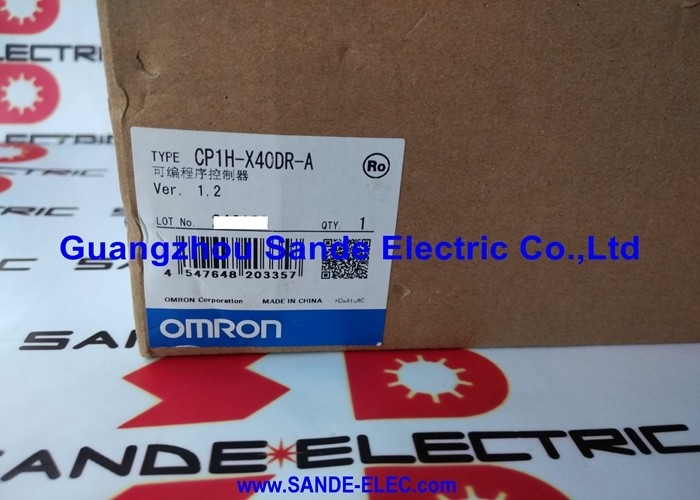
Omron CP1H-X40DR-A | CP1H Compact PLC — 24 DI + 16 Relay / AC 100–240V / 100kHz HSC ×4 / 100kHz Pulse Out ×2 / USB / 20K Steps / 0.1µs / IP20
100kHz High-Speed Counter + 100kHz Pulse Output — Motion on a Compact PLC
The CP1H-X40DR-A integrates four hardware high-speed counter channels and two hardware pulse output channels — not firmware-emulated functions, but dedicated counter/timer hardware that operates independently of the CPU scan cycle.
HSC (High-Speed Counter): Four channels accept single-phase encoder or sensor pulses at up to 100kHz, or two-phase (A/B quadrature) signals at up to 50kHz. The counters increment on every incoming pulse between programme scans, ensuring no count is lost regardless of scan time. Used for encoder position tracking, production counting, flow totalisation, and speed measurement.
Pulse Output: Two channels generate pulse trains at up to 100kHz, driving stepper motor controllers or servo drives in position or speed mode. The pulse output supports independent operation (each channel at its own frequency) or synchronised output (both channels locked to the same reference) for two-axis coordinated motion without an external motion controller.
Key Specifications
| Parameter |
Value |
| Digital Inputs |
24 × DC 24V (PNP/NPN) |
| Digital Outputs |
16 × relay, 2A/point, 8A/common |
| Programme Memory |
20K steps (~20 KB) |
| Data Memory |
32K words |
| Instruction Speed |
0.1µs |
| HSC Channels |
4 × (100kHz 1-phase / 50kHz A/B) |
| Pulse Output |
2 × up to 100kHz |
| USB Port |
1 (programming) |
| Power Supply |
AC 100–240V |
| Power |
approx. 30 VA |
| Temperature |
0°C to +55°C |
| IP Rating |
IP20 |
| RTC |
Built-in |
Sink/Source (PNP/NPN) Selectable Inputs — Global Sensor Compatibility
The 24 digital inputs select between sink (NPN) and source (PNP) operation by wiring configuration — no hardware jumper or model variant change needed. European machine conventions typically use PNP (source) sensors; Japanese and North American installations often use NPN (sink) sensors. The CP1H-X40DR-A's selectable inputs accommodate either convention, making it practical for machine builders who ship to multiple markets.
Optocoupler isolation between the 24VDC input field and the PLC's internal logic prevents ground loop currents and transient voltages from reaching the CPU — the field and logic sides are electrically independent.
Application Scenarios
Packaging machinery: Film feed, heat sealing, and product counting in one CP1H-X40DR-A. Pulse output drives the stepper motor for film advancement; HSC tracks the encoder on the cutting mechanism; relay outputs control the sealing element and reject actuator.
Conveyor sorting systems: 24 sensor inputs covering product detection at multiple conveyor sections. Relay outputs control diverter gates, conveyor motor contactors, and alarm lamps. Built-in HSC counts products on each branch.
Small machine tools and test equipment: Sequential control (clamping, cutting, unloading) via relay outputs. Encoder feedback through HSC. RS-232C for communication with a measurement instrument; USB for laptop programming access.
Water pump and HVAC stations: Level and pressure switch inputs to the 24DI. Pump motor contactors and valve solenoids on relay outputs. Built-in RTC for time-scheduled operations and event logging.
FAQ
Q1: Can the CP1H-X40DR-A replace a CP1H-X40DT-A (transistor output) in an existing installation?
Functionally the CP1H-X40DR-A (relay output) differs from the CP1H-X40DT-A (transistor output) primarily in output switching characteristics. Relay outputs switch AC or DC loads at mixed voltages; transistor outputs are DC-only but switch faster and have no mechanical wear. Programme logic is identical between the two variants. Field wiring differs because transistor outputs are either source or sink type, while relay outputs are voltage-independent contacts.
Q2: What expansion modules are compatible with the CP1H-X40DR-A?
The CP1H series supports CJ-series expansion I/O units connected via the CP1H's expansion I/O connector, and CP-series expansion I/O units. Up to 3 CP-series expansion units or CJ-series I/O units (via adapter) can be added. Analogue, temperature, and specialised I/O expansion is available through the CJ I/O expansion connector.
Q3: What programming tools and languages does the CP1H-X40DR-A support?
CX-Programmer is the primary programming environment for the CP1H. It supports Ladder Diagram (LD) and Instruction List (IL) programming in accordance with IEC 61131-3. The USB port connects a PC running CX-Programmer for programme download, upload, and online monitoring. CX-Designer is used for HMI panel development connected to the RS-232C or expansion port.
Q4: How does the built-in real-time clock (RTC) function?
The CP1H-X40DR-A's internal RTC maintains year, month, day, day-of-week, hour, minute, and second values in dedicated DM memory locations. The programme reads clock data and uses it for time-scheduled operations (start/stop at specific times), event time-stamping in data records, and recipe management that changes production parameters by shift or day.
Q5: What communication protocols are supported via expansion options?
Through the two option board slots, the CP1H-X40DR-A supports RS-485 (for Modbus RTU, CompoWay/F, and other serial protocols) and Ethernet (EtherNet/IP, TCP/IP socket communications). EtherNet/IP connectivity allows the CP1H-X40DR-A to participate in EtherNet/IP networks alongside CJ2 and NJ-series controllers as a device node. DeviceNet and PROFIBUS options are also available through specific option or communication boards.



 Your message must be between 20-3,000 characters!