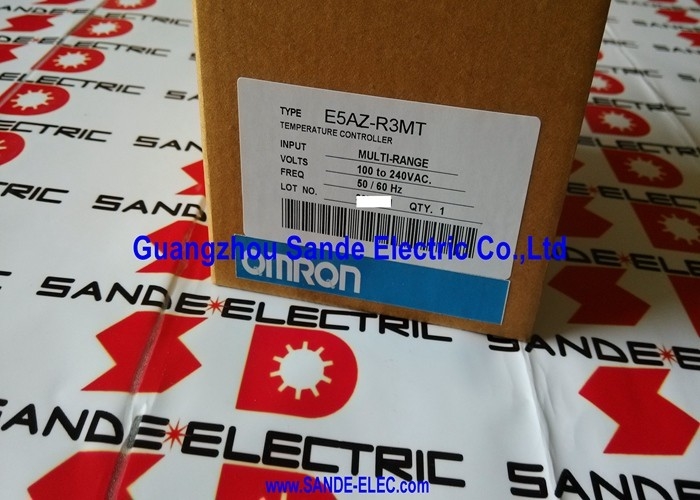
Omron E5AZ-R3MT Digital Temperature Controller
Overview
The E5AZ-R3MT is a digital temperature controller in the Omron E5AZ family. Published lineup data places this exact model in the 100 to 240 VAC power class and identifies it as a version with relay output and mounting option-unit support.
The wider E5AZ family documentation describes it as part of a controller series that handles thermocouple and resistance thermometer inputs and supports either ON/OFF or 2-PID control.
What makes this controller valuable in practice is the combination of process temperature regulation and flexible output configuration. In real panel work, a controller like this is usually chosen because the machine or process already depends on a defined temperature-control loop with a familiar front-panel interface, alarm handling, and relay-based control behavior.
That makes it especially relevant in installed systems where continuity and stable control behavior matter more than changing platforms.
This is an engineering inference based on the E5AZ family’s published control methods and the exact model’s relay-output classification.
Technical Data
| Parameter |
Value |
| Part Number |
E5AZ-R3MT |
| Manufacturer |
Omron |
| Product Type |
Digital Temperature Controller |
| Product Family |
E5AZ |
| Power Supply |
100 to 240 VAC |
| Input Type |
Thermocouple or resistance thermometer |
| Control Output |
Relay output |
| Control Method |
ON/OFF or 2-PID control |
| Mounting Option Units |
Supported |
| Typical Use |
Panel-mounted temperature control |
Application Value
The E5AZ-R3MT fits well in thermal-process panels, heater control systems, ovens, packaging heaters, utility temperature loops, and general process-control stations where a panel-mounted temperature controller is already part of the machine design.
Because the E5AZ family supports both thermocouple and resistance thermometer inputs, it is well positioned for applications that need flexible sensor compatibility within a dedicated controller format.
It also has practical maintenance value. The lineup information shows that the “MT” style is tied to option-unit support, which is useful in older systems that already rely on the same hardware configuration.
In replacement work, keeping the same family and output type usually simplifies setup and helps preserve the original field-side control arrangement.
This is an engineering inference based on the published E5AZ lineup and model grouping.
Replacement and Selection Perspective
For replacement work, the E5AZ-R3MT should be matched by power class, input type, output type, and hardware-option style, not only by the front-panel size.
In temperature-control systems, those details affect how the controller reads the sensor and how it drives the field side. Matching the same relay-output model usually helps preserve both wiring and tuning expectations in the machine.
This is an engineering recommendation grounded in the published E5AZ family specifications and the exact lineup entry for E5AZ-R3MT.
FAQ
Q1: What kind of product is E5AZ-R3MT?
It is a digital temperature controller in the Omron E5AZ family. In practical use, it is meant for dedicated thermal control loops rather than for general PLC logic tasks.
Q2: What applications fit it best?
It fits heater panels, thermal process stations, ovens, packaging heaters, and general machine temperature loops where a dedicated controller with relay output is already part of the design.
This is an engineering inference based on the E5AZ family’s temperature-control role and the model’s relay-output configuration.
Q3: Why is relay-output matching important on this controller?
Because the controller’s output style determines how it interacts with the field side.
In a replacement project, keeping the same relay-output model usually preserves wiring and output behavior more reliably than switching to a different control-output style.
This is an engineering inference based on the exact model’s published relay-output classification.
Q4: What gives this controller flexibility in sensor choice?
The E5AZ family is published for thermocouple and resistance thermometer inputs, which makes it useful across a wider range of temperature-sensing applications than a single-sensor-type controller.
Q5: What should be checked before ordering?
Check the installed model code, confirm the 100–240 VAC supply class, verify the required sensor type, and make sure the system uses the same relay-output and option-unit style.
Those checks usually matter more than cosmetic similarity.



 Your message must be between 20-3,000 characters!