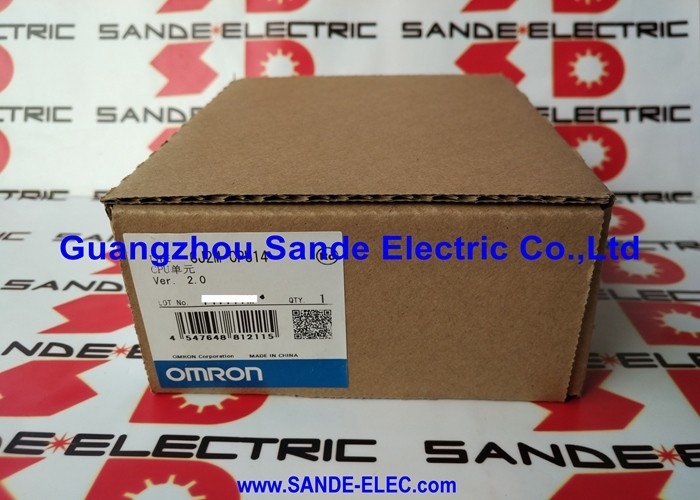
Omron CJ2M-CPU14 | CJ2M Modular PLC CPU — 50K Steps / 160K Words / 0.04µs / 40 Expansion Units / 2560 I/O / RS-232C + USB / 31mm
The CJ2M — A Modular CPU, Not a Compact Controller
Understanding the CJ2M-CPU14 starts with understanding what modular means here. This CPU module has no built-in I/O. Unlike the CPM2A compact PLC (also in this session) which integrates digital inputs and relay outputs in the CPU housing, the CJ2M-CPU14 is a pure processor — it slots into a CJ-series backplane alongside separately selected I/O, function, and communication modules. Every input and output point is a separate, freely chosen module decision.
This architectural difference is not a disadvantage — it is the design choice that makes the CJ2M-CPU14 appropriate for systems too large, too diverse, or too complex for a compact controller to handle. A 50,000-step programme accommodates extensive recipe management, alarm processing, data logging, motion coordination, and safety interlock logic in a single project. 160,000 words of data memory holds the corresponding data structures — large datasets that a 4,096-step compact PLC runs out of memory to manage.
The CJ2M family positions itself above the CPM/CP1 compact range and below the NJ/NX Sysmac-platform controllers. The CPU14 is the second-highest model in the CJ2M CPU range: CPU11 (5K steps), CPU12 (10K), CPU13 (20K), CPU14 (50K), CPU15 (60K). For systems that need substantial processing power without moving to the full Sysmac architecture, the CPU14's 50K step capacity covers the majority of mid-to-large machine automation requirements.
Key Specifications
| Parameter |
Value |
| Programme |
50,000 steps |
| Data Memory |
160,000 words |
| Execution Speed |
0.04 µs/basic instruction |
| Max. Expansion Units |
40 |
| Max. Local I/O |
2,560 points |
| Built-in I/O |
None |
| Communication |
RS-232C + USB |
| Dimensions |
31 × 90 × 84.5mm |
| Weight |
~130g |
0.04µs Execution — What Speed Means in a Scan Cycle
The 0.04 microsecond basic instruction execution time translates directly to scan cycle performance. A programme with 10,000 ladder rungs executes the boolean instructions in approximately 0.4ms — leaving substantial scan cycle time for communication processing, special instruction execution, and PLC overhead. For machines with tight cycle time requirements — high-speed inspection systems, multi-axis coordination, or processes that must respond to state changes within single-digit milliseconds — this execution speed ensures the logic overhead does not become a constraint.
At 50,000 steps, the programme may include complex structured text functions, motion instruction blocks, and communication handling alongside the core machine logic. The 0.04µs execution rate ensures that even a heavily loaded programme runs within a manageable scan time.
40 Expansion Units, 2560 I/O — System Scale in Practice
The CJ2M-CPU14's 40-unit expansion limit across up to 2,560 local I/O points supports large machine configurations. In a mid-size automated assembly cell with 200 digital inputs, 150 digital outputs, 20 analogue input channels, 8 analogue output channels, and two high-speed counter modules, the CJ2M-CPU14 manages all I/O within one rack system — no distributed I/O needed until the count exceeds the local limit.
For systems that do need distributed I/O, CJ2M-compatible PROFIBUS, EtherNet/IP, and DeviceNet master and slave modules extend the reach beyond the local rack.
Application Scenarios
Multi-cell manufacturing systems: Sequential control across multiple machine cells with recipe management, real-time status reporting to SCADA, and alarm handling. The 50K step programme and 160K word data memory accommodate the complete system programme in one CPU without memory constraints.
Material handling and sortation: Sensor-rich environments with many photoelectric and proximity inputs plus conveyor motors, pusher solenoids, and sorter outputs. The 2,560 I/O capacity handles large systems from a single CPU.
Process and utility control: Temperature control loops, flow monitoring, valve sequencing, and data logging — programme size and data memory requirements easily exceed what compact PLCs can provide.
FAQ
Q1: What is the difference between CJ2M-CPU14 and CJ2M-CPU13?
The CPU13 provides 20,000 programme steps and 64,000 words of data memory. The CPU14 provides 50,000 steps and 160,000 words — 2.5× the programme space and 2.5× the data memory. Both support the same maximum 40 expansion units and 2,560 I/O. Choose CPU13 when the programme fits within 20K steps; choose CPU14 when larger logic, recipe tables, or data storage require the additional capacity.
Q2: How does the CJ2M-CPU14 differ from the CPM2A-60CDR-A in the same product session?
The CPM2A is a compact fixed-I/O controller — the CPU and all I/O are integrated in one housing, programme capacity is 4,096 steps, and maximum system I/O is 120 points. The CJ2M-CPU14 is a pure modular CPU with no built-in I/O, 50,000 steps, and up to 2,560 I/O points via separate expansion modules. Use the CPM2A where a complete self-contained controller handles the task; use the CJ2M-CPU14 for larger systems where programme complexity, I/O count, or module specialisation require a modular architecture.
Q3: What I/O modules are compatible with the CJ2M-CPU14?
The full CJ-series I/O module range: digital input (CJ1W-ID2xx), digital output (CJ1W-OD2xx), analogue I/O (CJ1W-AD04x, DA041), high-speed counter (CJ1W-CT021), temperature input (CJ1W-TS561), and communication modules including EtherNet/IP (CJ1W-EIP21), PROFIBUS slave (CJ1W-PBD21), and DeviceNet master (CJ1W-DRM21). CJ1-compatible modules operate in CJ2M racks.
Q4: What programming software is required?
CX-Programmer (part of the CX-One package) for ladder logic, ST, SFC, and FBD programming via the USB or RS-232C port. CX-Programmer V9.x and later support CJ2M-specific instructions and function blocks. Sysmac Studio does not programme the CJ2M; Sysmac Studio targets the NJ/NX Sysmac platform.
Q5: Where is the CJ2M-CPU14 sourced?
Through Omron's authorised distribution network for current production, and through the CJ2M aftermarket for tested or refurbished units. The CJ2M platform is actively manufactured and distributed; the CPU14 is a current product available through standard Omron channels. Confirm the programme capacity (50K steps) and data memory (160K words) match the installed or planned system before ordering — adjacent CPU13 (20K steps) and CPU15 (60K steps) models have different memory allocations.



 Your message must be between 20-3,000 characters!