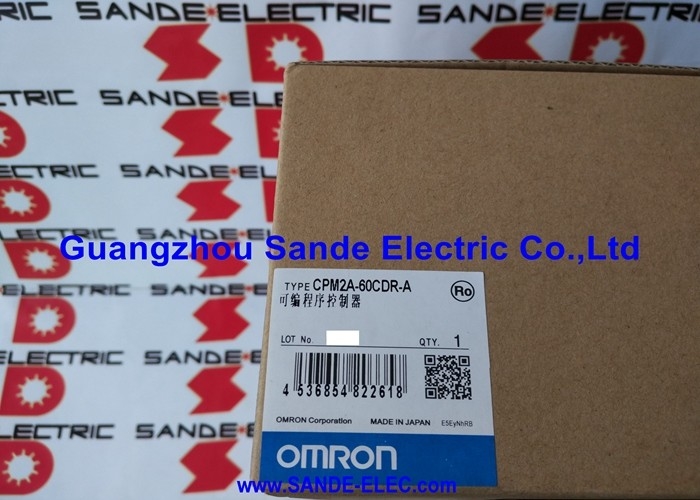
Omron CPM2A-60CDR-A | CPM2A Compact PLC — 36 DI / 24 Relay Outputs / 100–240VAC / RS-232C / 4096 Steps / Expandable to 120 Points
60 Points Without a Rack — The CPM2A-60CDR-A's Architecture
The CPM2A-60CDR-A is the largest standard model in the Omron CPM2A compact PLC family. Thirty-six digital inputs and 24 relay outputs integrated into one AC-powered housing — no rack required, no backplane to assemble, no separate power supply module. The full 60-point I/O capacity is available from the day the controller is mounted on the DIN rail and wired.
This compact "brick" architecture is the defining practical advantage for small machine control. A packaging station, conveyor system, or utility control box that needs 30 sensors and 20 actuators can be built around a single CPM2A-60CDR-A and a terminal strip — a simpler, more cost-effective installation than the same I/O count spread across a rack-based CPU plus multiple signal modules.
The 24 relay outputs accommodate mixed-voltage field loads without additional hardware. Motor starter coils at 230VAC, solenoid valve pilots at 24VDC, signal lamps at whatever voltage the machine uses — all connect directly to the relay contacts, which are electrically isolated from the PLC's internal logic in each channel.
Key Specifications
| Parameter |
Value |
| Digital Inputs |
36 × DC |
| Digital Outputs |
24 × relay contact |
| Supply |
100–240V AC |
| Programme |
4,096 steps |
| Timer/Counters |
256 |
| RS-232C |
Built-in |
| Pulse I/O |
Yes |
| Max. I/O (expanded) |
120 points |
| Status |
Discontinued spare |
Built-In RS-232C — Direct Device Connectivity
The CPM2A-60CDR-A's built-in RS-232C peripheral port connects programming terminals, HMI displays, barcode readers, and serial data devices directly — no additional communication module needed. In the CPM2A architecture, this port handles both programming access (CX-Programmer or SYSMAC-CPT) and runtime serial device communication.
For compact machine panels where a single small operator panel needs to display machine status and accept operator input, the built-in RS-232C provides the connection without consuming a module slot or adding wiring complexity.
Application Scenarios
Conveyor and material handling: 36 inputs monitor belt sensors, position switches, and photoelectric detectors. 24 relay outputs control motor contactors, diverter gates, and alarm outputs. The AC supply connects directly to the panel mains circuit without a separate SMPS.
Packaging machine control: Pneumatic valve pilots (24VDC), motor contactors (230VAC), and counter outputs all connect to relay contacts without voltage-matching hardware. Built-in pulse output supports simple length counting or positioning without a separate function module.
Legacy system spare: Many CPM2A-60CDR-A units remain in service globally. A direct replacement preserves the original I/O address map, communication port configuration, and relay output wiring — no programme modification required.
FAQ
Q1: What is the difference between CPM2A-60CDR-A and CPM2A-60CDT-A?
The -60CDR has 24 relay contact outputs. The -60CDT has 24 transistor (solid-state) outputs. Relay outputs switch both AC and DC loads at millisecond speed; transistor outputs switch 24VDC only at microsecond speed. Choose relay for mixed-voltage loads and infrequent-cycle actuators; choose transistor for high-speed DC loads, pulse outputs, and frequent-cycle pneumatic valves.
Q2: How many expansion units can be added, and what types are available?
Up to two expansion units can be added to the CPM2A-60CDR-A, bringing maximum system I/O to 120 points. Available expansion units include 20-point relay output (CPM2A-20EDR), 20-point transistor output (CPM2A-20EDT), and 4-channel analogue input (CPM2A-4AD). One analogue output expansion unit is also available.
Q3: What programming software connects to the CPM2A-60CDR-A?
CX-Programmer (Omron's standard IEC 61131-3 programming environment) connects via the built-in RS-232C port using a USB-to-RS-232 adapter and a CS1W-CN226 or equivalent cable. The legacy SYSMAC-CPT software also supports the CPM2A. CX-Programmer V9 and earlier versions are required — the current CX-One package includes a compatible version.
Q4: Does the CPM2A-60CDR-A support analogue I/O?
The base CPU has no built-in analogue channels. Analogue capability is added via expansion units: the CPM2A-4AD provides 4 analogue inputs (0–10V or 4–20mA), and the CPM2A-2DA provides 2 analogue outputs. Maximum one analogue input and one analogue output expansion unit per system.
Q5: Where is the CPM2A-60CDR-A sourced after discontinuation?
Through the established Omron CPM2A aftermarket — industrial automation spare parts dealers, tested surplus suppliers, and legacy PLC specialists. The CPM2A has a large global installed base from the 1990s and 2000s; aftermarket availability for the -60CDR-A is generally reliable. Confirm the -A (AC supply) suffix matches the installed unit before ordering.


 Your message must be between 20-3,000 characters!