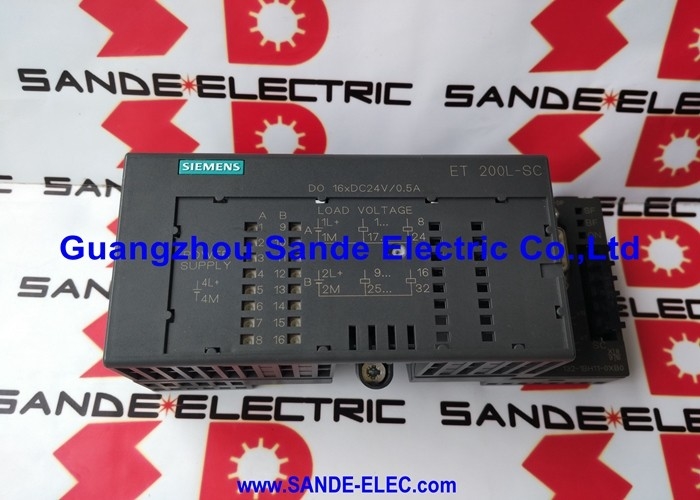
Siemens 6ES7132-1BH11-0XB0 | SIMATIC ET 200L-SC Digital Output Module — 16 DO 24VDC / 0.5A, Expandable to 32 Channels via Smart Connect TB 16SC
Overview
The Siemens 6ES7132-1BH11-0XB0 is the 16-channel digital output electronic block for the SIMATIC ET 200L-SC distributed I/O platform — a compact, DIN-rail-mounted system that puts PROFIBUS DP slave I/O directly at the machine, close to the sensors and actuators, instead of routing individual signal cables back to a central panel.
The ET 200L-SC concept splits the I/O module into two physical components: an electronic block (this unit) that contains the output switching circuits, status LEDs, and PROFIBUS logic, and a terminal block that carries the screw-clamp field wiring terminals.
This separation gives the ET 200L-SC an important maintenance advantage — when the electronic block fails, it lifts off the terminal block in seconds, and a replacement snaps in without touching a single wire. All the field wiring stays connected; the I/O station is back in service after a hardware swap rather than a rewiring job.
The 6ES7132-1BH11-0XB0 provides 16 transistor-type 24VDC outputs, each rated at 0.5A.
These are solid-state switch outputs — no moving contacts, essentially unlimited switching life, and fast enough to switch at the PLC scan cycle rate without introducing timing delays.
For a distributed I/O station controlling sixteen solenoid valves, sixteen contactor coils, or a mixed set of actuators at a machine location, sixteen 0.5A channels cover the vast majority of practical output requirements without any additional components.
The Smart Connect (SC) designation indicates this electronic block is compatible with the ET 200L-SC terminal block system, which includes the TB 16SC terminal block (providing the base 16-channel wiring interface) and an optional expansion terminal block that adds another 16 channels.
This means a single 6ES7132-1BH11-0XB0 electronic block can grow to 32 output channels simply by adding the expansion terminal block on the right — no additional PROFIBUS address, no additional power supply module, and no additional configuration in STEP 7.
The expanded 32 channels share the same electronic block's processing and communication resources.
Key Specifications
| Parameter |
Value |
| Output Channels |
16 DO |
| Output Voltage |
24V DC |
| Max. Output Current |
0.5A per channel |
| Expandable |
Yes — +16 ch via TB 16SC |
| Max. Channels (expanded) |
32 |
| Output Type |
Transistor (solid-state) |
| Communication |
PROFIBUS DP |
| Weight |
0.18 kg |
| Platform |
ET 200L-SC |
ET 200L-SC Architecture — Electronic Block + Terminal Block
The ET 200L-SC system's physical design is worth understanding because it shapes how the module is installed, replaced, and configured:
The terminal block is the static component — it mounts on the DIN rail and provides the screw-clamp terminals for all field wiring. Once the field cables are connected during commissioning, the terminal block stays in place permanently.
Its terminals are accessible from the front whether or not the electronic block is installed.
The electronic block (this 6ES7132-1BH11-0XB0) clips onto the terminal block from the top, making the backplane connection that links the output switching circuits to the field terminals below.
When powered, it participates in the PROFIBUS DP scan cycle, receiving output data from the DP master and switching its output channels accordingly.
For routine output bit updates — turning solenoids on and off, activating indicator lamps — the exchange is simple: the S7 CPU writes output bits in its process image; the DP master transfers those bits over PROFIBUS to the ET 200L-SC; the 6ES7132-1BH11-0XB0 sets its output transistors accordingly, sourcing 24VDC current to the connected actuators.
This happens every DP cycle, continuously, as long as the PROFIBUS link is active and the master is running.
Smart Connect Expansion — Growing to 32 Outputs
The TB 16SC terminal block provides the physical connection points for the 6ES7132-1BH11-0XB0's sixteen output channels. Adding the expansion terminal block extends the physical wiring capacity to 32 channels — 16 on the base TB 16SC and 16 on the expansion block.
The electronic block automatically recognises the expanded configuration and maps both sets of terminals to output channels in the PROFIBUS I/O data without any manual configuration.
This expansion mechanism is relevant for machine designs where the I/O count at a station grows between engineering phases.
A machine initially specified with 16 outputs at a particular location might require 20 or 24 outputs after detailed engineering, or after a machine upgrade adds sensors and actuators.
With ET 200L-SC Smart Connect, the expansion is mechanical — add the terminal block, connect the additional field wires, and the new channels appear in the STEP 7 hardware configuration automatically.
There is no need to replace the electronic block or reconfigure the PROFIBUS address.
24VDC / 0.5A Output Ratings — What They Power
The 0.5A per channel rating covers the standard range of 24VDC actuators in machine automation:
Standard pneumatic solenoid valves draw 0.1A to 0.4A at 24VDC — well within the 0.5A limit. Small contactor coils (up to IEC AC-3 Class 4–5kW) draw approximately 0.1A to 0.3A at 24VDC when controlled through 24VDC coil variants. Indicator pilot lamps (LED type) draw typically 0.02A to 0.1A.
Interposing relay coils for voltage or current range conversion draw 0.05A to 0.2A.
The 0.5A rating is not adequate for directly switching 24VDC motor loads, large contactors with high coil inrush, or high-power resistive heaters.
For these loads, an interposing relay or solid-state relay serves as the interface between the 0.5A output and the higher-current load circuit.
FAQ
Q1: Can the 6ES7132-1BH11-0XB0 be used with any PROFIBUS DP master, or is it restricted to Siemens S7 CPUs?
The ET 200L-SC communicates as a standard PROFIBUS DP slave and is compatible with any PROFIBUS DP master that can use the ET 200L GSD file (General Station Description). Siemens STEP 7 and TIA Portal include the ET 200L hardware in their device catalogs; for non-Siemens masters, the GSD file provides the configuration data needed by third-party engineering tools.
Practically, the ET 200L-SC works with any IEC 61158-compliant PROFIBUS DP master, including those from Schneider Electric, Beckhoff, Phoenix Contact, and others.
Q2: The module is described as expandable to 32 channels. Is the -1BH11-0XB0 electronic block sufficient for 32 channels, or does a larger electronic block exist?
The 6ES7132-1BH11-0XB0 electronic block itself handles the full 32-channel expanded configuration — no larger variant is required.
The electronic block's internal processing and PROFIBUS communication resources are sized for the expanded 32-channel I/O map.
The expansion is purely physical: adding the expansion terminal block doubles the wiring capacity without requiring an electronic block upgrade.
For systems requiring more than 32 outputs at a single PROFIBUS address, a second ET 200L-SC station at a second PROFIBUS address is required.
Q3: What is the output response time — how quickly does an output switch after the PROFIBUS data arrives?
The transistor output switching time of the 6ES7132-1BH11-0XB0 is in the range of 0.1 to 1ms from the moment the new output data is loaded from the PROFIBUS receive buffer to the output terminal changing state.
The total latency from S7 CPU output bit change to field terminal change also includes the PROFIBUS DP bus cycle time (typically 1–10ms depending on configuration) and the S7 CPU's output image update mechanism.
For time-critical output switching requirements, the PROFIBUS DP bus cycle time and CPU configuration are the dominant factors; the electronic block's own switching time is comparatively small.
Q4: Can the outputs of the 6ES7132-1BH11-0XB0 be forced on or off from the STEP 7 programming interface during commissioning?
Yes. STEP 7 and TIA Portal support I/O forcing for PROFIBUS DP slaves including ET 200L-SC modules.
In online monitoring mode, individual output channels can be forced to a specific state (0 or 1) for commissioning verification — checking that each solenoid valve, contactor, or indicator responds correctly before the control program is put into active operation.
Forced outputs override the program's normal output values and should be cleared before returning to normal production to prevent unexpected actuator states.
Q5: Does the -0XB0 suffix indicate a specific product variant or region of this module?
Within Siemens SIMATIC product numbering, the final portion of the order number (here -0XB0) identifies the product revision, packaging type, or approval variant.
The -0XB0 suffix on this module designates the standard production version without special certifications (the "XB" element typically indicates standard international approval and packaging).
Variants with -0AB0, -0XA0, or other suffixes exist for specific market or approval requirements.
For standard industrial automation applications outside of special environments (Ex zones, marine, etc.), the -0XB0 variant is the standard selection.



 Your message must be between 20-3,000 characters!